

It’s 7:50 pm EST. Welcome to the last bits of Friday evening’s Golden Hour.
Note: When I started writing here, I said I chose “Golden Hour” to represent the duality of beauty and survival. And that my goal is to write on fighting in — and through perilous times.
For photographers, the golden hour refers to the times of day when the sun bathes everything it touches in favorable, life-giving light. For emergency medical professionals, the golden hour refers to 60 minutes after a traumatic injury, after which the likelihood of permanent injury or death increases.
In the aftermath of my father’s death, focusing on discipline, beauty, and survival has taken on new, almost obsessive meaning for me.
So on Fridays, find me here — morning or evening golden hour, Eastern time.
At the very least, let the Golden Hour alert hitting your inbox serve as a cue to look outside and remember to find whatever light you can in these dark times.
And if you do go outside and touch grass, come back and read my posts, of course. ;)
When the weapon that is formed against you— is your own husband
For anyone who grew up in the church, the verse from Isaiah is commonly quoted: “No weapon formed against me shall prosper.”
But for Black women, all too often, the weapons formed against us are the men sleeping in our beds and living in our homes.
And as two recent high-profile killings of Black women just this month have shown, no amount of church vows, political connections, or professional success will protect us from a putrid system that incubates the social contagion that is male violence against Black women.
Earlier this month, Nancy Metayer, who was the vice mayor of Coral Springs, Florida, and a rising democratic political star, was found shot to death in her home. Police arrested Stephen Bowen, who was married to her. He was charged with premeditated murder and tampering with evidence.
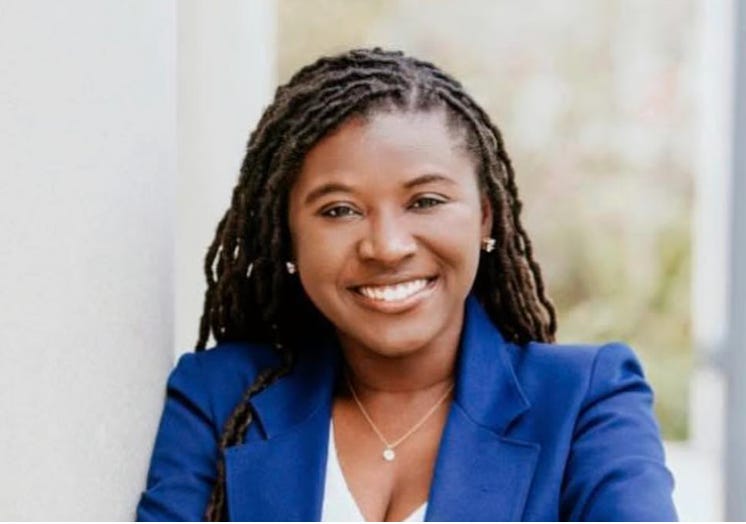
This morning, the political world was shocked by the news that Dr. Cerina Wanzer Fairfax, a beloved dentist, was shot to death in her home by Justin Fairfax, a former Lt. Governor. He was married to her at the time, though she was in the process of divorcing him. Instead of facing justice and accountability, Cerima’s killer shot and killed himself, leaving their two teenage children orphaned.

And these are just two high-profile cases. According to the CDC, Black women comprise 14% of the US population, but account for about 30% of homicides resulting from partner violence. According to the same study, the number of Black women who were killed rose during the pandemic. And in a majority of those cases, a gun was involved. And we know that one of the most dangerous times for a woman in a relationship with a man is when she tries to leave or divorce him. (I’ve also written before about how pregnant women and women who have recently given birth are also at risk of being killed by their partners)
But the violence that took these women’s lives isn't the only dangerous instrument that women, and Black women in particular, have to deal with when murdered by men they were married to at the time of their deaths.
The discourse and media framing of Dr. Cerina’s murder have been as predictable as they are disappointing. “Justin Fairfax Was Once A Rising Star before Scandal Sank His Career”, reads a headline from the Associated Press. “Justin Fairfax’s rapid rise in Virginia Politics Flamed Out After Scandal”, reads a headline from the Washington Post. What really happened wasn’t a “scandal” — Fairfax was accused of sexual assault by two women (he was never charged). But the stories are framed about his career, his rise, his fall
Now, as a former editor, I know that those outside of the DC / Maryland / Virginia area may just be coming to find out about Fairfax’s political career— and these types of headlines help feed the internet’s sudden interest in learning who the Lt. Governor was.
At the same time, we love when Black men’s careers fall from grace— and, if the Black man played his cards right, we can see how this narrative is an easy detour into “family-man-who-committed-heinous-act-must-have-had-mental-issues” route. A number of those stories have had photos accompany them of Justin and Cerina together— their wedding photos, family pictures with their children, and a well-circulated photo of (a sad-looking) Cerina at Justin’s side at his swearing-in ceremony. “Divorce judge was concerned about Justin Fairfax’s recent mental health, 2022 gun incident, court documents show” reads a headline from WTOP. Journalist Roland Martin came under intense criticism for a now-deleted Instagram post that showed him posing with Justin Fairfax at various glittery events, with Cerina touting the membership in the same Black Fraternity. He convened a panel on Black men’s mental health as a response.
We know certain things to be true of men, family, violence, and power in this country. We’ve all seen the darkly pointed memes of how the media treats regular white men who annihilate their entire families.


Studies have shown that “Reporters frequently distance male perpetrators from their violence by presenting a range of circumstances that are interpreted as relating to or having caused their violence, including mental illness, substance abuse, financial difficulties, and criminal reputation”.
According to a California survey of stories of domestic violence, survivors are very rarely quoted.
What happens when the woman doesn’t survive to tell her own story?
Cerina’s story— who she was as a mother, dentist, community member, are, as of now, sidelined. I am sympathetic to the calls to “center” female victims of violence, instead of the mental health of their male killers— who ultimately, made a choice. I think as the news cycle goes on, we will get more of those stories that focus on Cerina. However, it is just a fact that the person with more fame will generate more attention.
So again— how can we defend against the twin weapons of male violence and media’s coddling of violent men?
Here’s a small symbolic thing that members of the media can do— we can strip these men of their family status, of their right to maintain posthumous access and connection to the women whose lives they took. We know very well that men benefit professionally and socially from being seen as devoted husbands and fathers.
We can take some inspiration from what Metayer’s family did and at least symbolically strip them of the right to claim possession of the wives that they killed.
According to the Miami Herald, ”In the days since Metayer’s shocking death, the councilwoman’s family and the city’s Instagram have dropped Bowen from her name, using Metayer only — a name that defined not just her Haitian lineage but her roots in activism, a path that some who knew her said ushered her into politics”.
Men who kill their female partners and wives should, at the absolute fucking minimum, lose their right to be called partners, husbands, or family men.
There is a reason that even in this post, I said that Cerina and Nancy were married to these men at the time of their murders —I will not call them husbands. There’s a reason why I put “partners” in quotes in the headlines. They are now their wives’ killers.
These men made the choices to change their relationship status from being these women’s life partners — to being their life-takers. And our coverage should reflect that.
I know, subtle, symbolic things like changing language can feel like throwing grains of sand against the missile-loaded juggernaut of systemic male violence against women, and against Black women especially.
But we gotta keep throwing rocks at the tank of violent patriarchy. We might not be stopping the machine. But maybe we can crack a window.
Thank you for writing this. As a survivor of domestic violence, I do wince at these headlines. It's so hard for women to get out of a DV situation, and yet, we are the ones who are villainized and not to be believed. Thank you Thank you Thank you
Minor correction, the late dentist’s name was Dr. Cerina W. Fairfax.
Incredibly well said, and I wish we lived in a universe where an article like this never had to be written. As always, thank you for your words.